
Most customer success teams have already “adopted AI.” Someone drafts emails with a chatbot. Someone else runs call notes through a summary tool. Then progress stops.
Kristi Faltorusso has spent 14+ years in B2B SaaS customer success and has advised more than 3,500 companies. She sees this pattern constantly. In a recent issue of her newsletter, she described a client that came to her wanting to “figure out AI” for its CS team. There was no mandate and no direction, and everyone was using chat tools differently and calling it a strategy.
She didn’t start with tools. She started with a question most teams never ask out loud: what do you complain about, what do you avoid, and what do you know you should be doing but never have time for?
Building that list took the team several days. Nobody had ever asked them to catalog their friction before. When they finished, they had 22 real gaps in how they ran the customer journey. Those were 22 problems worth solving, not 22 use cases for a tool.
The part everyone skips
Next, every idea on the list had to justify itself. Kristi ran each one through a ten-field framework covering everything from the business objective and owner to the data required, the actual workflow, the baseline, and the KPIs that would prove it worked. If an idea couldn’t answer all ten, it wasn’t ready. (She shares the full framework in her newsletter. It’s worth stealing.)
The ideas that survived were ranked, assigned owners, and put on a timeline. When the team met with its executives, it wasn’t asking for permission. It came with a plan that already had momentum.
Kristi’s diagnosis of where CS teams get stuck is blunt. It isn’t a knowledge problem. The teams pulling ahead treat AI as infrastructure rather than a feature. They catch churn signals weeks earlier, build health scores from real behavior instead of gut feel, and prepare for business reviews in thirty minutes instead of four hours.
That gap is growing. So we built a program to close it.
Meet the Customer Success AI Shipyard
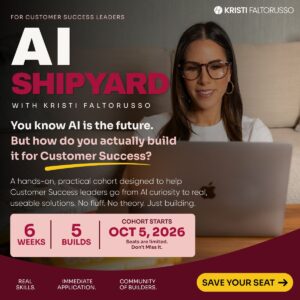
The Customer Success AI Shipyard with Kristi Faltorusso is a six-week cohort where CS professionals stop reading about AI and build the systems themselves, using their own book of business.
The program uses the AI Shipyard method from Aspireship: non-technical professionals learn AI by studying real builds and then rebuilding them for their own work. In this edition, Kristi’s retention and expansion strategies are the curriculum, and her frameworks set the standard your work is reviewed against.
Five systems, built to work together
- Predictive customer health and churn prevention. A multi-signal early-warning system that flags accounts whose trajectory is slipping and pairs each flag with the play to run.
- Account intelligence and “what changed?” summaries. One current account narrative covering what changed, what’s at risk, what was promised, and what should happen next, ready before every meeting.
- Conversation intelligence and commitment tracking. Decisions, next steps, owners, blockers, and sentiment shifts pulled from calls and emails, so verbal commitments don’t disappear.
- Goal definition and value realization tracking. Vague goals turned into measurable outcomes with a baseline, target, and owner, plus the proof of value for the QBR and the renewal.
- Renewal risk and growth identification. The commercial layer: a clear read on which accounts will renew, contract, or expand, with the evidence and next-best action behind it.
If you’ve read Kristi’s newsletter, these will look familiar. Churn prediction, dynamic health scoring, QBR prep, call summarization, renewal forecasting, and sentiment analysis are the starting points she recommends. The Shipyard is where you actually build them.
How it works
- Weeks 1–4: Weekly 60-minute live sessions. Kristi kicks off the cohort live, and the Aspireship team runs the weekly build sessions.
- Weeks 5–6: You build your own versions, with Slack support throughout.
- Build time: About 3–5 hours per week.
- Recordings and study guides after every session, so a missed week doesn’t mean missed material.
- A credential that reflects what you built, not just what you studied.
Everything is built in Claude Cowork in plain language. No code and no engineering background are required. You start with sample CS data from Aspireship, then rebuild using your own exports. You never have to connect live company systems.
Who it’s for
- CSMs and senior CSMs who are buried in prep and want those hours back.
- CS leaders who’ve been asked what the team’s AI plan is and want an answer that runs on real systems.
- CS Ops and Enablement, who will be asked to scale whatever works and are better off building it first.
Save your seat
The first cohort starts Monday, October 5 at 12pm EST. Seats are $697, and spots are limited. A Claude Pro or Team subscription is required and purchased separately. Many companies cover the cost: we provide a reimbursement letter and can invoice team seats directly. To bring your whole team or set up a private cohort, email [email protected].
As Kristi puts it, the tool is the easy part. The work is building the list, structuring the plan, and owning the outcome. This is six weeks to do that work.


